Shell huts, Grosvenor Gardens

Hazelle Jackson’s lovely little book on Shell Houses and Grottoes inspired me to discover more about the two unusual shell huts in Lower Grosvenor Gardens, just across the way from Victoria Station. With more than a little help from Westminster City Archives and one of the current gardeners, the Londonphile has pieced together the story of these intriguing little structures.
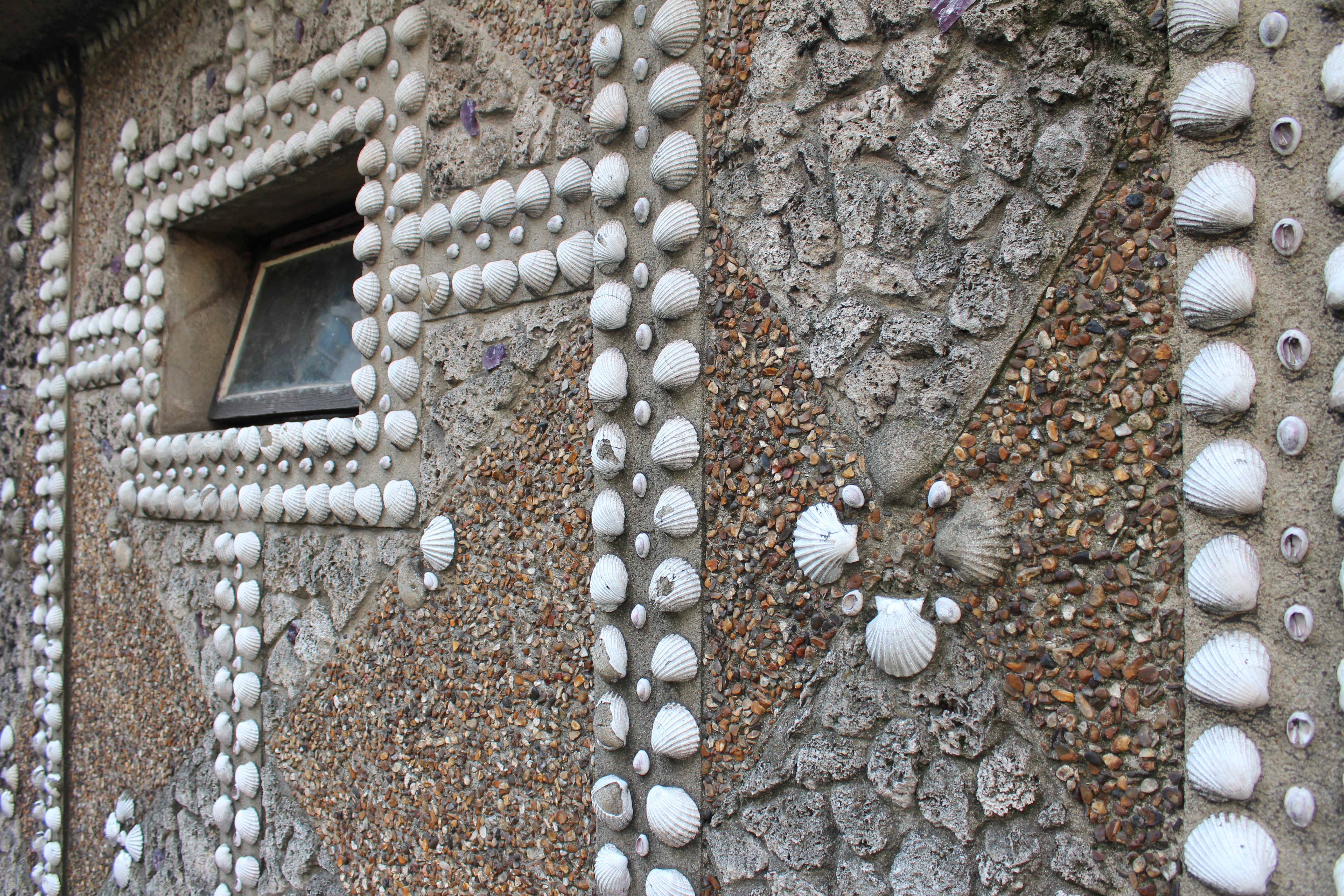
The shell huts were built in 1952 as part of a re-landscaping of the Lower Grosvenor Gardens in a French style to commemorate Marshal Foch and Anglo-French understanding. The gardens already had a statue (by Georges Malissard) of Foch – the French hero of the First World War – which was erected in 1930. During the Second World War, Grosvenor Gardens was covered with air raid shelters and littered with dust and debris, so a clean-up was in order. An initial one took place in 1948, at which time the photograph below was taken, giving us some idea of how the gardens looked at this point.
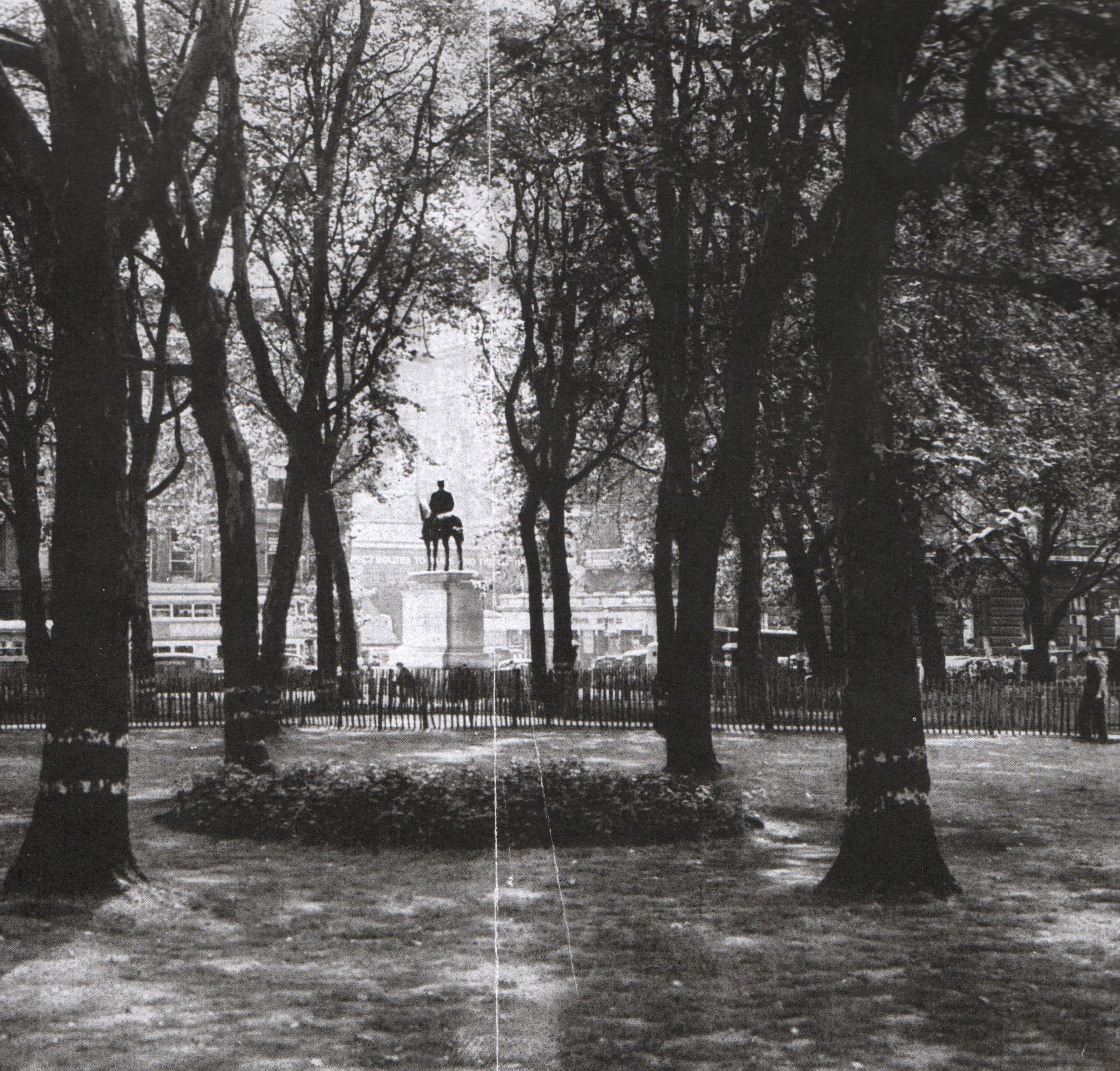
1948 view. Source: 'The Sphere', 4 September 1948.

As part of the new French look, a number of the existing large trees were removed, a large arabesque pathway formed with gravel, and a fleur-de-lis centre-piece composed with flowering plants. These changes were not to everyone’s liking, and it’s amusing to read newspaper accounts from the time, some of whose comments (‘inexplicable’, ‘completely useless’, ‘perhaps they are going to stand the thing on end’, ‘wallpaper patterns turned into paths’) seem to express a certain lack of regard towards French design and certainly a sense of loss about the shady, grassy areas that were no more. The official opening ceremony for ‘London’s French garden’ was held on 18th July 1952, when the French Ambassador dedicated it to Foch’s memory.

1952 view. Source: 'The Builder', 1 August 1952.

The two shell huts – and indeed the rest of the park – were designed by the then architect-in-chief of the National Monuments and Palaces of France, Jean Moreux, who also designed the Institut Francais library in South Kensington. Some of the shells adorning the huts were brought over from France, while it was thought that others would also be sourced from English beaches – making for a very cross-cultural construction indeed. The huts were said to be ‘in the style of those small pavilions that were known as fabriques in eighteenth-century France’  – the old French term for what is known as a folly in the U.K.

Under construction. Source: 'The Sphere', 24 May 1952.

Despite their whimsical decorations, the huts were in fact designed with a practical purpose in mind: they were for the use of the park’s gardeners, with one designated for the storage of tools and the other ‘for the attendant’. However, a very helpful current garder told me that they now only have access to the western hut – the eastern hut is kept locked. He was kind enough to unlock the hut still in use – and as the photo below shows, it is still used for garden storage today, including a lawnmower.
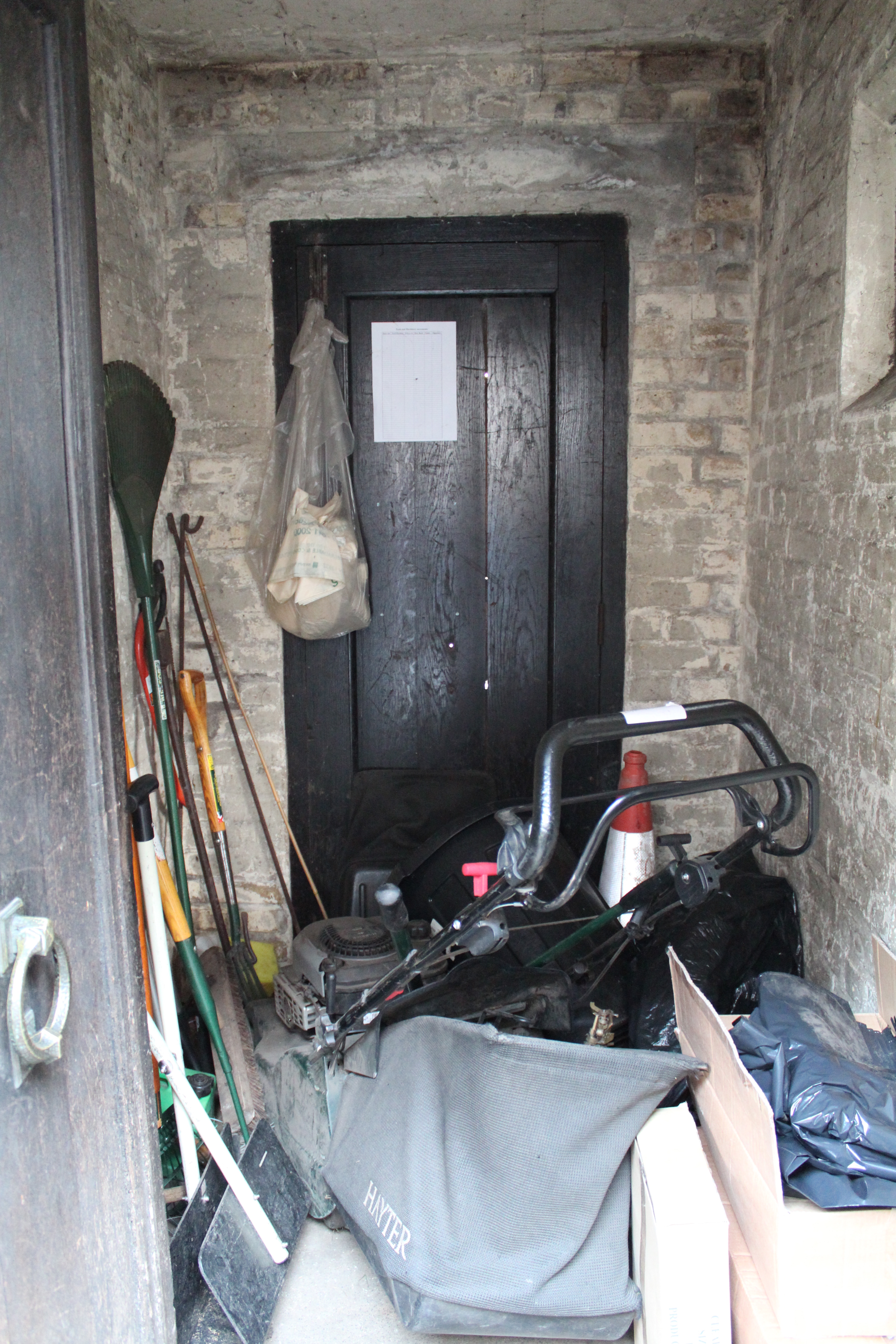
Inside the hut.

Intriguingly, the park seems to have changed yet again over time. The central fleur-de-lis motif has disappeared, and the curving arabesque gravel paths have been replaced by asphalt ones, still following circular lines but with a central path. This has meant that more of the grassy zones have been able to re-colonise the garden – which no doubt would have greatly pleased the aforementioned writer who bemoaned their loss. But the huts still remain – one has some graffiti on its door but otherwise they seem in remarkably good condition, with most of their cross-cultural shells still attached.

Westminster Council’s Lower and Upper Grosvenor Gardens page

Westminster City Archives’ website

At risk: Cross Bones

This post marks the first in a new series for the Londonphile, featuring London sites that are at risk. These may be facing closure due to financial problems, demolition due to development or simply decaying before our eyes. These posts will advise how you can best register your support – perhaps by signing an online petition, or boosting attendance figures by paying a visit.

Cross Bones Graveyard has long been an at risk heritage site – it was rejected as unsuitable as a building site as far back as 1883 – and it has been featured in the media of late as it is again being marketed for development. Although much of the Cross Bones site is at first glance a concrete wasteland – owned by Transport for London and currently used for storage – it is in fact the last resting place of over 15,000 people. And while anyone who has read Catharine Arnold’s Necropolis will know that the dead can be found all across London, Cross Bones’ unique history makes the site a particularly significant one.

As the plaque on its gate advises, Cross Bones was home to the ‘outcast dead’, an unconsecrated ground used for the burial of prostitues or, as they were known locally, ‘Winchester Geese’ – so-called because they were licensed to ply their trade within the Liberty of the Clink in Southwark by the Bishop of Winchester. Despite this protection, these women were not deemed fit for Christian burial, and their graveyard was appointed ‘far from the parish church’. Although the exact age of the burial ground is not known, it was mentioned in John Stow’s 1598 A Survey of London. It later became a pauper’s cemetery – tellingly in 1665, the year of the Great Plague – in an area with no shortage of slums (and body-snatchers). It closed to burials in 1853 when it was declared over-full and a risk to public health and decency.

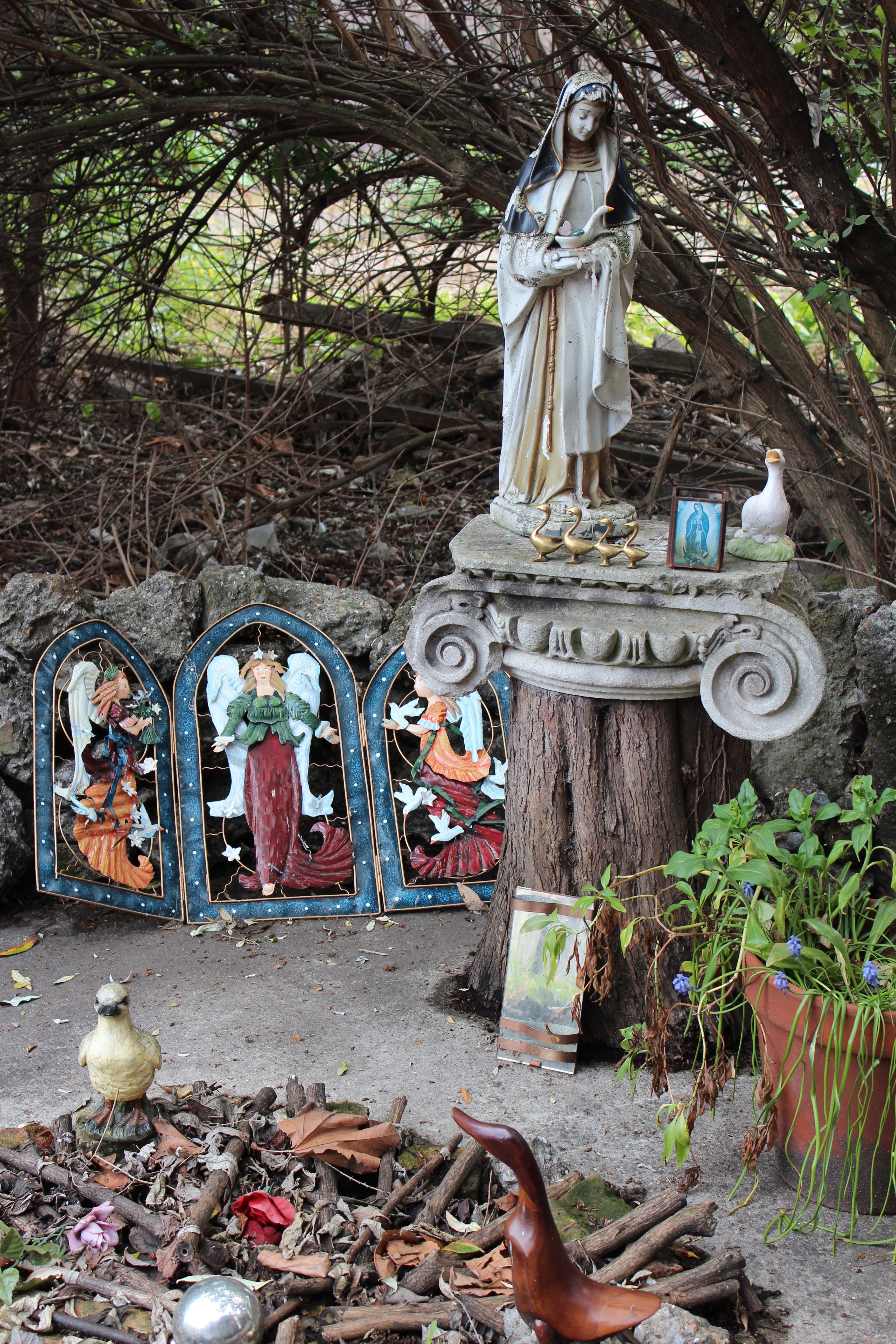
Today the Memorial Gates are festooned with ribbons, cards and flowers – a tradition which started at the 1998 Halloween ceremony – and small shrines have been placed on the site. The colourful, celebratory nature of these offerings adds greatly to Cross Bones’ atmosphere, and is also what makes it so very different – appropriately enough, given its outcast nature – to most English graveyards. A closer look inside the site reveals a statue of Mary in an almost grotto-like setting amongst trees, accompanied by a number of ornamental geese. These days, the Shard is also a constant presence, looming high above the site.

Local writer John Constable, who has long been a leading campaigner in the fight to protect Cross Bones, now hopes that at least part of the site can be retained as a Garden of Remembrance and a public park, and the Memorial Gates preserved.

What you can do: sign the online petition here
Vigils are also held at the site at 7pm on the 23rd of each month, as is an annual Halloween festival. At 7pm on Monday 23rd April there will be a special vigil to mark St George’s Day and the coming of spring.

Cross Bones is located on Redcross Way SE1, opposite the Boot and Flogger pub.

http://www.crossbones.org.uk/

London’s troughs and fountains

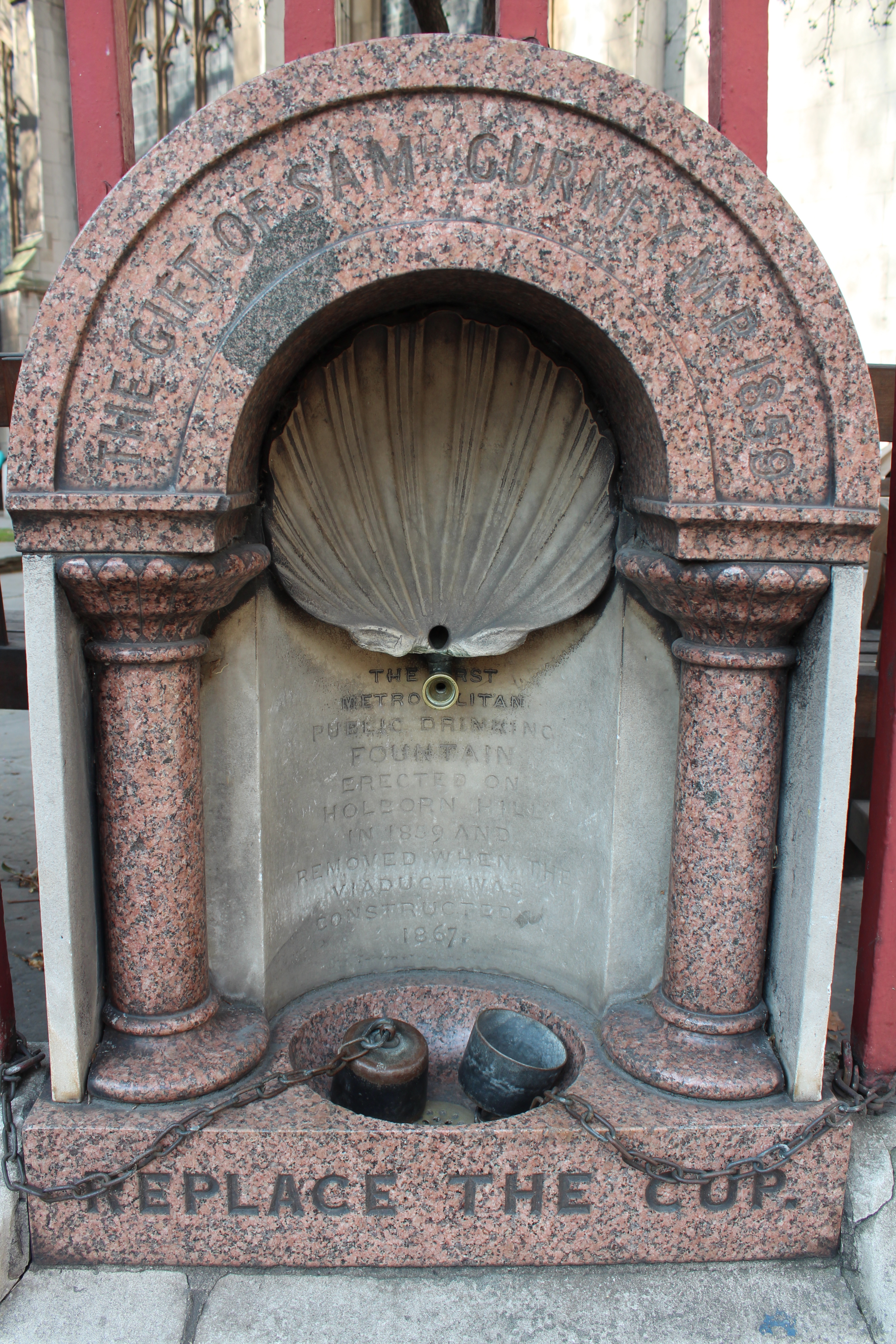
The Londonphile wandered past this (former) drinking trough positively overflowing with spring blooms on Surrey Quays Road last week and set out to learn more about its history. The Metropolitan Free Drinking Fountain Association (as it was originally known) was formed in 1859 to provide free, clean drinking water to Londoners at a time when the Thames carried water-borne cholera and beer was cheaper than fresh water.

The first fountain - complete with drinking cups.

The first drinking fountain to be provided by the Association was set along the wall of St Sepulchre’s Church on Snow Hill (EC1) in April 1859, and was soon quenching the thirst of around 7,000 citizens each day. It still exists today, although it is now located on the other side of the church, on the corner of Newgate and Giltspur Streets. Originally, fountains such as this one generally featured somewhat unhygienic drinking cups, attached on chains. These were later replaced with upward jets of water, not surprisingly due to health concerns.

Within eleven years 140 fountains and 153 cattle troughs had been provided by the Association. They had been quick to realise the desperate need for refreshment faced by the many animals both living in and visiting London – many of whom were driven into the capital for days on end, often without water. By 1865 most fountains also featured a trough for dogs, and in 1867 the group officially changed its name to the Metropolitan Drinking Fountain and Cattle Trough Association.

The Surrey Quays Road trough is a typical granite cattle trough (circa 1900), which incorporates a drinking fountain on one end. Like a number of old troughs, it now serves as a flower bed, and features an inscription of the Association’s old address, 10 Victoria Street London S.W. It has a rather colourful recent history with the original trough having been stolen (you can see a photo of its rather bereft-looking stand here). It was replaced with the current trough – which possibly hails from Kent – in 2010.

The Drinking Fountain Association (as it is now known) is still very much active today, especially in the provision of drinking fountains at playing fields and schools, and still receives requests to help thirsty animals. They have long conducted work overseas, especially in developing countries.

Fancy becoming a trough spotter? You can find/report your local London trough to http://www.londontroughs.co.uk/ a site which aims to collate all of the remaining troughs in the capital.

The website of the Drinking Fountain Association can be found at: http://drinkingfountains.org/

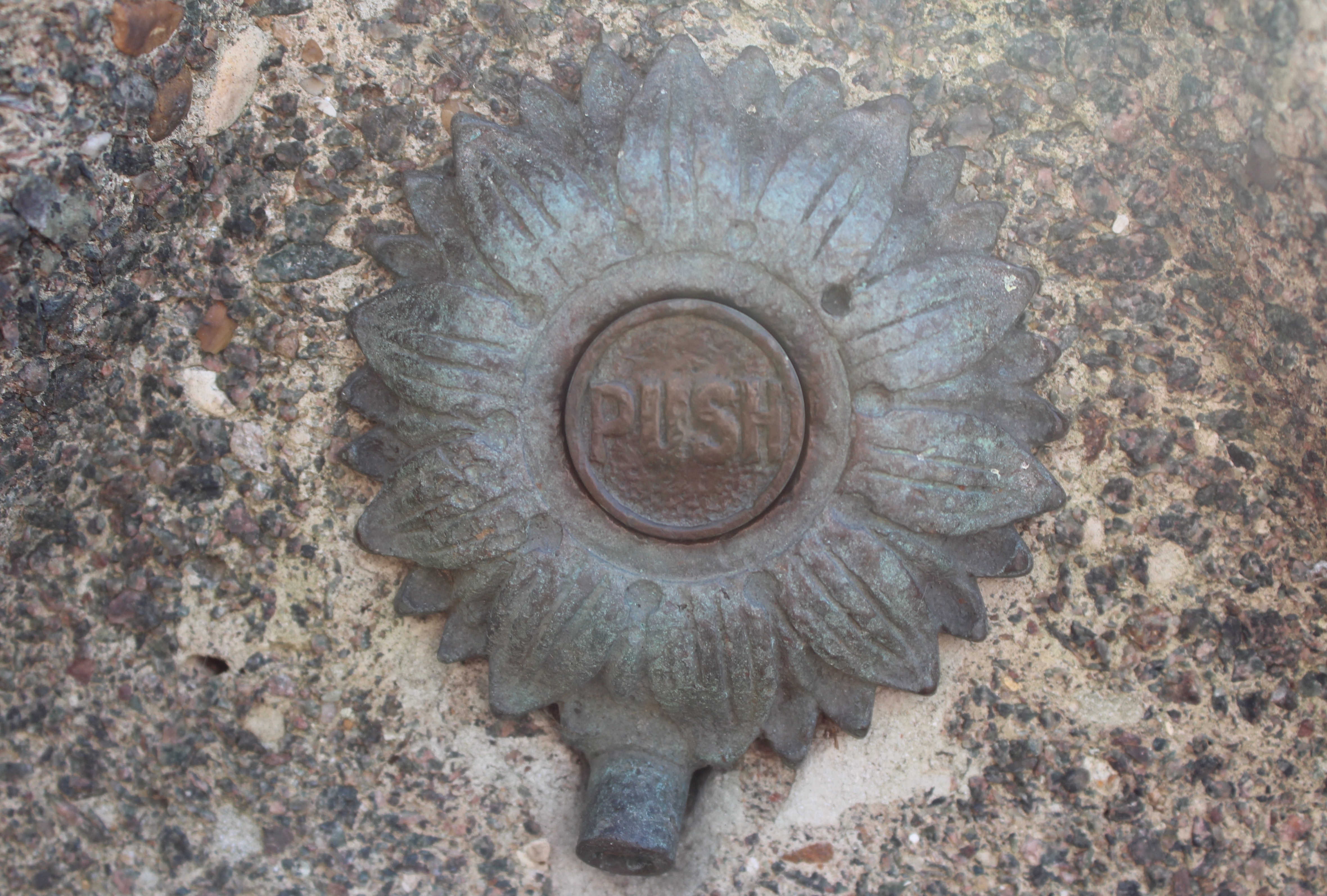
Detail from the drinking fountain on the side of the Surrey Quays Road trough.

St Dunstan-in-the-East

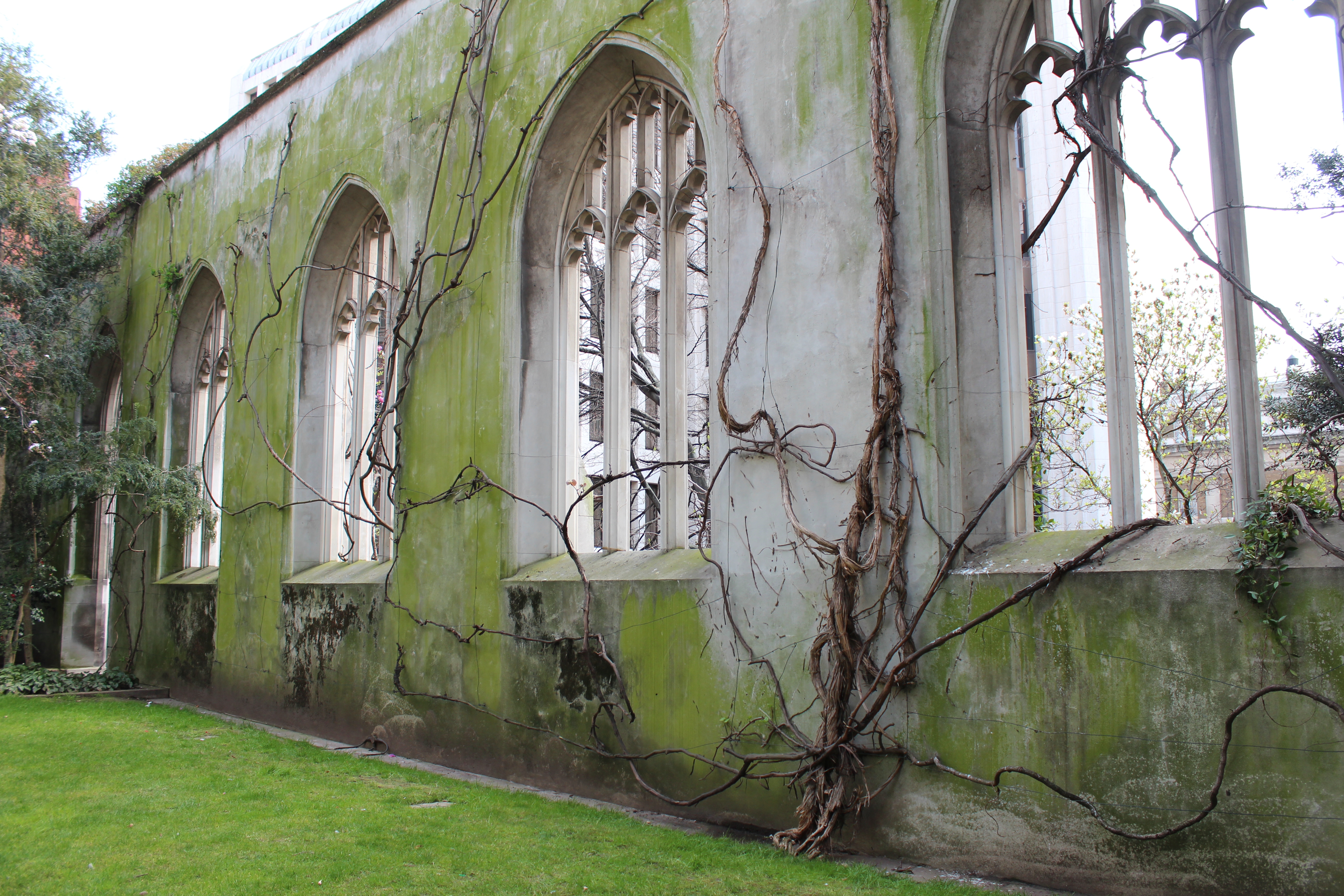
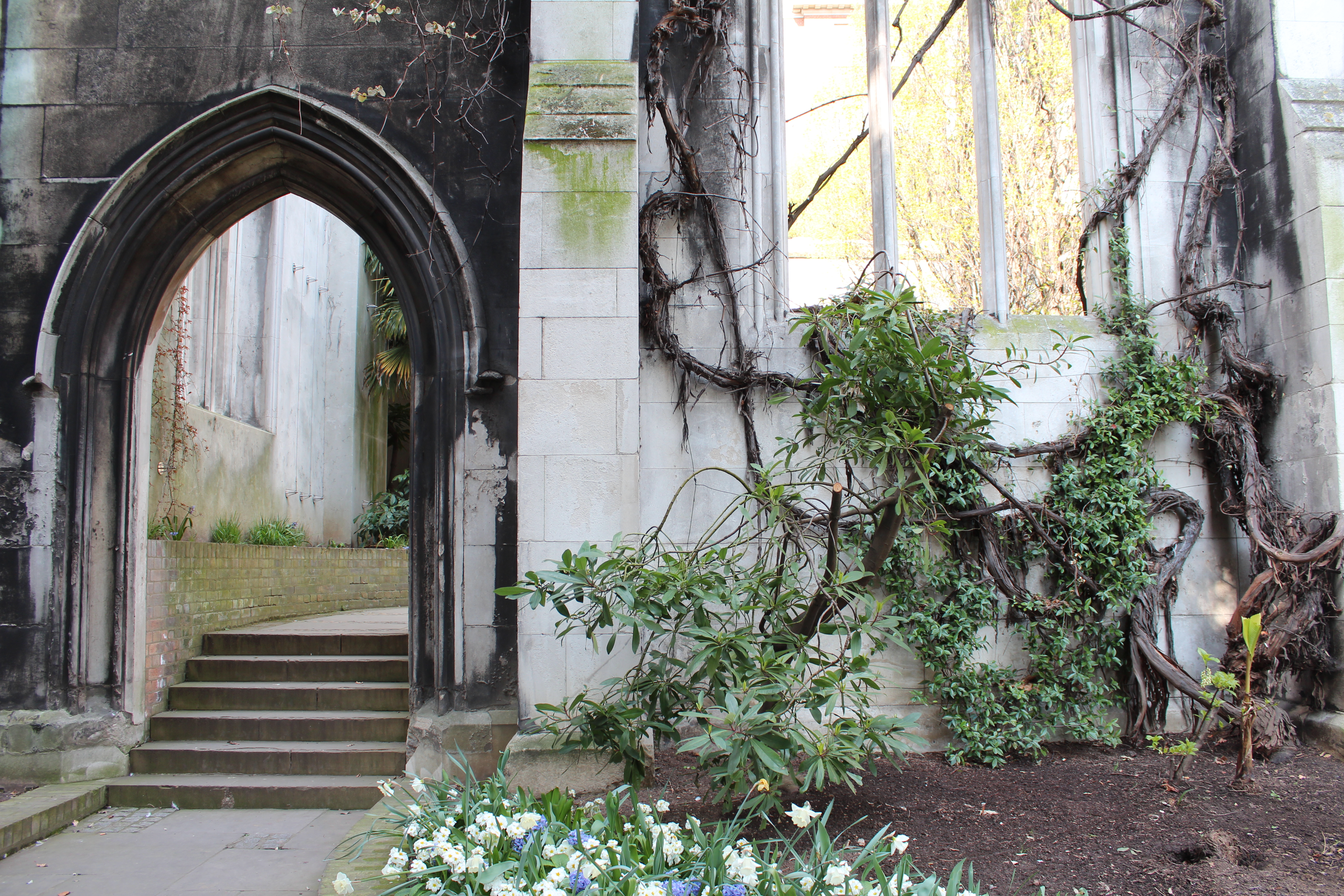
St Dunstan-in-the-East must be one of the more unique and atmospheric lunch spots on offer for City workers, who eat their sandwiches amongst the bombed-out remains of a medieval church. The church itself had a complex history, having been touched by two of the major historical events in London: the Great Fire and the Blitz.

Originally built in 1100, St Dunstan’s was slowly rebuilt after being badly damaged in the Great Fire, including the addition of a steeple designed by Sir Christopher Wren, who matched his design to suit the original Gothic style of the church. Serious structural damage was uncovered in 1817, which prompted another rebuild between 1817 and 1821. Finally, the church was hit in the 1941 Blitz, leaving only a shell  – and Wren’s steeple.

This was the final straw for St Dunstan’s and it was decided not to rebuild it yet again. Although the bells were replaced in the tower in 1953, they were deemed unsafe to use as without any support the tower would list greatly when they were rung. The bells themselves had a rather sad end – two were destroyed during the dismantling and relocation process in 1970 (one was actually broken up in the tower as it was slightly too large to remove), and they now grace a Californian winery.

The garden has fared much better – it was designed in 1971 by the then London Architects and Parks Department, who planted twisting creepers and exotic plants amongst the ruins and Wren’s steeple to create this secluded little haven in the City. The different areas of the church make for a nice choice of seating areas. The parish was combined with All Hallows by the Tower, who occasionally hold open air services in St Dunstan’s – such as the one this weekend for Palm Sunday at 11am.

You can find the garden between Idol Lane and St Dunstan’s Hill in the City.

Magpie Alley Crypt

Next time you find yourself in Fleet Street why not take a cheeky detour along Magpie Alley? This little lane not only commemorates the area’s history but contains a hidden surprise for visitors in the form of a late 14th century crypt.

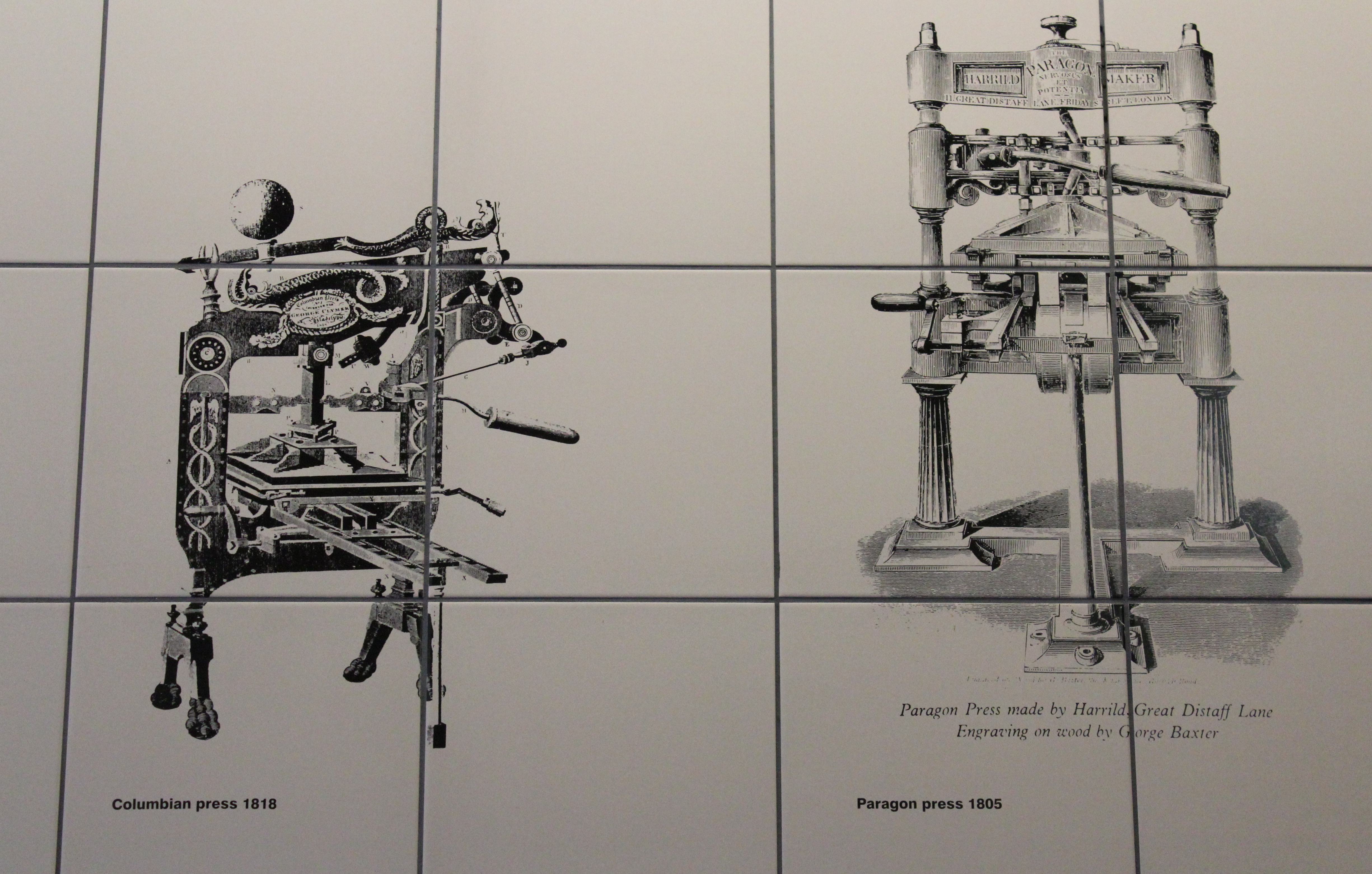
A wall of illustrations, photos and text along the alley celebrates the area’s long association with the printing and newspaper industries. These flourished here for centuries, starting with the early printing presses (circa 1500), right up until the late 1980s when the last newspapers left in search of cheaper rents.

Venture to the end of the alley and down the flight of stairs directly in front of you and you will find the remains of the crypt – imprisoned behind glass in the basement of a law firm. This site was home to the Carmelite Order of the White Friars since 1253. Their domain once stretched from Fleet Street to the Thames, and at one time included a church, cloisters, cemetery and garden. After Henry VIII disbanded the priory in the mid-16th century and gifted the land to his doctor the buildings deteriorated, with the crypt at one stage having the rather unglamorous function of a coal cellar.

The crypt’s remains were re-discovered in 1895 during construction, and it was restored in the 1920s. It was originally located on the eastern side of the site but was moved to its present location – balanced on a concrete raft – when it found itself on the wrong side of re-development in the late 1980s after the newspapers’ exodus.

Magpie Alley is not searchable on Google maps – adding to its secretive nature – but can be found off the eastern side of Bouverie Street, towards the Fleet Street end. The ‘lantern’ you will see if you look through the crypt’s arch burns day and night.

Sydenham Hill Wood and Folly

‘A folly might be defined as a useless building erected for ornament on a gentleman’s estate’ – Barbara Jones.

‘The mark of a true folly is that it was erected to satisfy and give pleasure to the builder, and greatly to surprise the stranger’ – Sir Hugh Casson.

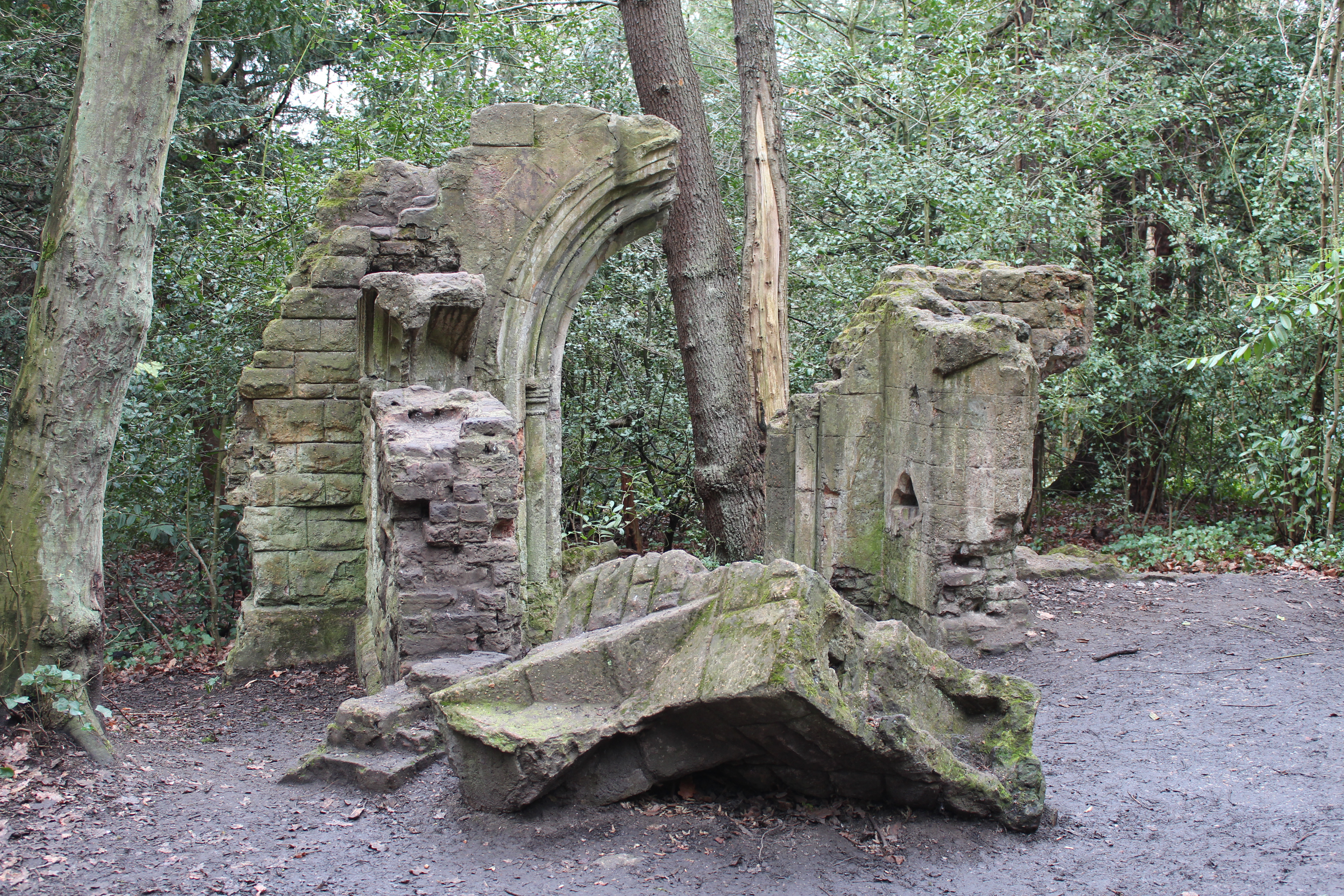
While there is much debate about how exactly to define a folly, there’s little doubt that many visitors must be fooled by this folly in Sydenham Hill Wood. These ‘ruins’ actually only date back to the Victorian era, and were built as an impressive garden feature in the grounds of a large house once on the site – Fairwood, which was built around 1864. Its owner, Alderman David Henry Stone (later a Lord Mayor of London), contracted the firm of James Pulham & Son (inventor of the artificial Pulhamite rock) to construct these sham ruins. Ruins had been a popular type of folly since the late seventeenth and eighteenth centuries, when wealthy landowners inspired by their Grand Tours of Europe wanted to re-create some of the classical sights in their own gardens.

The folly and rockery

The Sydenham folly depicts a ruined church or monastery – apparently remains of stained glass were still present in the windows back in the 1950s and early 1960s. It’s thought that the arch would once have been complete – although it’s hard to be precise when you’re talking about ruins, and fake ones at that! There are also the remains of a rockery leading down to what was once an ornamental stream. Previously a group of six or seven large houses, including Fairwood, had been built on this 9-hectare site, but these were demolished by the end of the 1970s and the area returned to a woodland state (with a few Victorian era plants thrown in for good measure). It has been managed by the London Wildlife Trust since 1982.

Although it was the folly that drew me to Sydenham Hill Wood, this little slice of woodland also has several other points of interest. As difficult as it is to believe given its rather pristine current state, a railway line once ran right through this area – and not just any line, but the Crystal Palace line transporting people from Nunhead to the Crystal Palace. Camille Pissarro painted the view from the Cox’s Walk Footbridge in the wood in 1871 (see picture below left), which looks remarkably different today (below right). You can also see the 1865 tunnel mouth that the railway once passed through – now home to a colony of bats. Much like the story in Vauxhall, this is an open space that has reverted to type, in this case with the wood and its inhabitants reclaiming the space.

Sydenham Hill Wood is located in SE26 – there are entry points on Crescent Wood Road and Sydenham Hill. Forest Hill and Sydenham Overground are the closest stations, while the buses that will get you here are the 363 and 356. It even has its own Twitter account: @SydenhamWoodLWT

London Wildlife Trust Sydenham Hill Wood page

If you’d like to see more photos of the folly you can visit the Londonphile’s Flickr set.

Clissold House

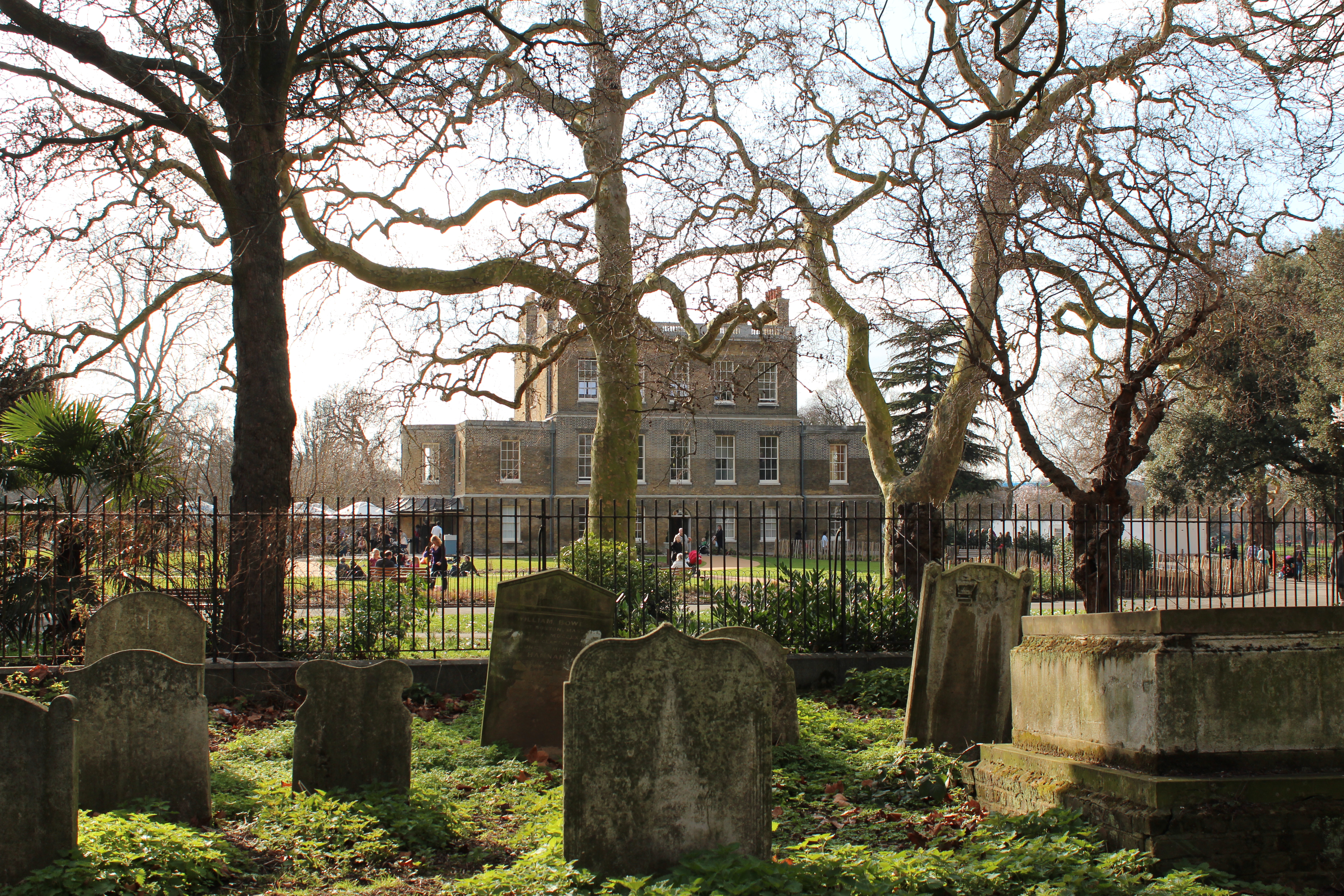
As I approached Clissold House around a bend in the river I was met with the delightful vista above. But no, Clissold House is not located in a peaceful little village in the English countryside but in Hackney (Stoke Newington, to be precise), and I think you will agree it makes for a rather pretty – if somewhat unexpected – picture. Clissold House, which dates from 1793 (architect unknown) and is located in Clissold Park, has recently undergone a £4.46 million restoration courtesy of Lottery funds, so the Londonphile popped by for a little look-see and a tour of the property.

Eastern side - the front.

The original owner of Clissold House, Jonathan Hoare, chose the site for its proximity to the New River, an artificial river opened in 1613 to bring fresh water to the capital. This once flowed past the house and continued as far as Clerkenwell, and has now been restored and extended to resemble its original appearance. Another spot of artifice is found in the construction of the grassy knoll that the house appears to sit on; this was built up on the western side of the house on top of a series of vaults, which are still used for storage today. This created an architectural oddity, with the house having two storeys on the western side and three on the east. Also a matter of much confusion is the question of which side is actually the front of the house. While important guests were received on the carriageway at the western side, the more restrained eastern side – which looked across to the village and the church (St Mary’s Old Church, not the larger church in the top picture) – was actually the front of the house.

The story of how Clissold House – originally named Paradise House – came into its new name is another intriguing part of the house’s history. William Crawshay, who bought the property in 1811, forbade his daughter Eliza to marry her beloved curate from across the lawn at St Mary’s. So they simply sat and waited, watching each other from across the way, until William died and Eliza inherited the house and married her man: Reverend Augustus Clissold. As they had no children and their family were not interested in the property after their deaths, it was bought first by the Ecclesiastical Commissioners and later – following a vigorous public campaign to turn it into a public park – by the Metropolitan Board of Works, who opened Clissold Park in 1889.

Reverend Clissold's view from St Mary's to the eastern side of the house.

As the original plans for the house have yet to be discovered, the recent restoration took place along best-guess lines with regards to layout. The lovely old oak floorboards have been retained, while the highlight is definitely the spiral staircase, which reaches up towards a glass dome. And take a moment to visit the poignant memorial drinking fountain on the northern side of the house – still in use today, and complete with trough for animals at the base – that a Crawshay family member erected in memory of her three young sisters who had died in infancy almost sixty years previously.

Free 30-minute tours of the house were arranged to mark the re-opening, and although they were originally only intended to run for couple of months have proved so popular that they will continue for the time being. As much of the house is now used as a cafe and a community space you can have a mooch around much of it by yourself, though a tour will get you into a few extra rooms and is also worth it for the fascinating story of the house (although there are some information panels in the western cafe if you’d rather do it yourself). I’m told the people at Clissold House still hope to find out more about the property and its history, so if any historians out there stumble across anything do let them know!

Email clissoldhouse@gll.org to book tours; these are generally held on Tuesday and Saturday afternoons.

http://www.hackney.gov.uk/clissold-house.htm

The Barbican Estate

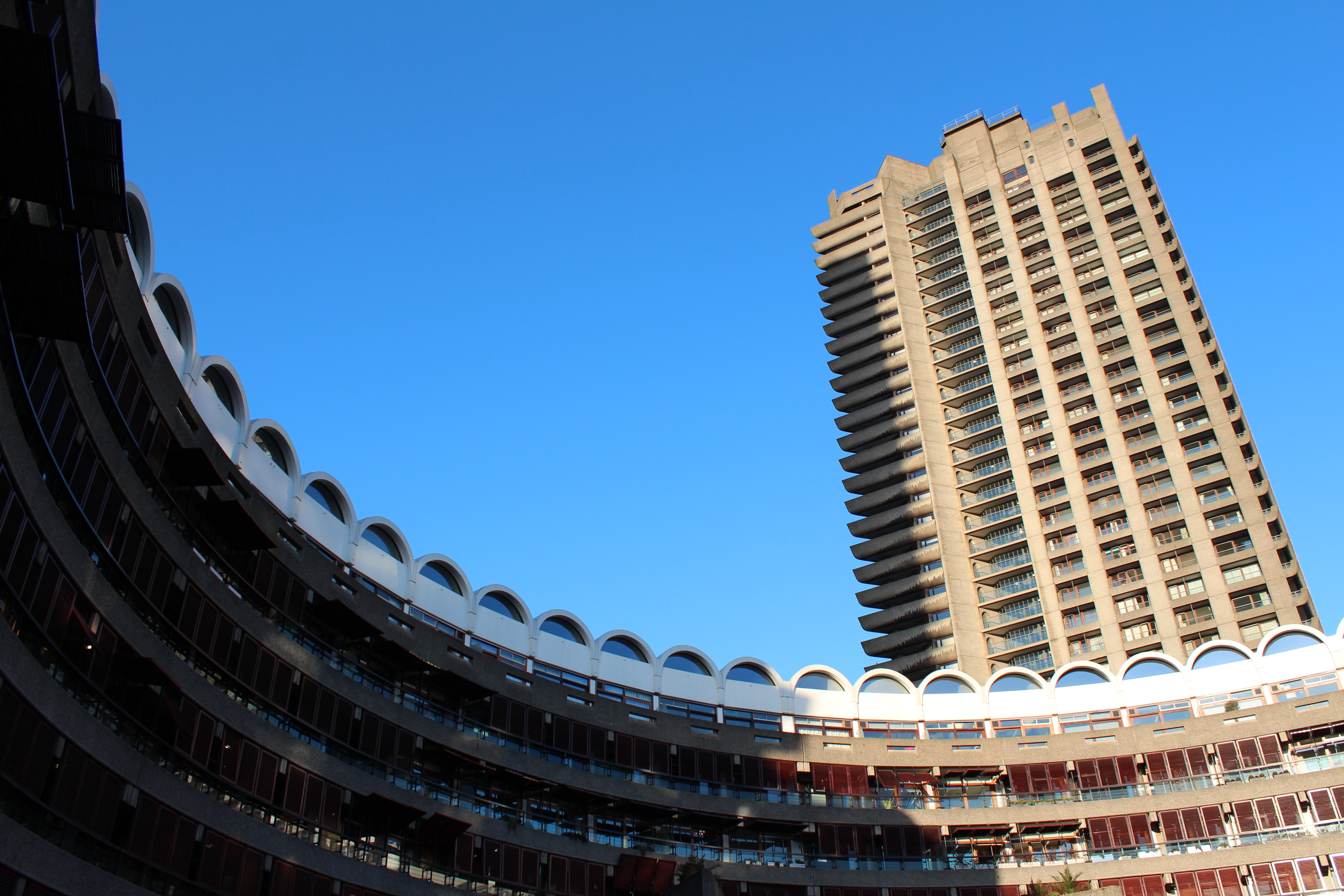
A tower looms above Frobisher Crescent

A tower looms above Frobisher Crescent

If you like your architecture to come with a strong dose of brutalism and lashings of retro styling, then you’ll love the Barbican. The Londonphile is a big fan but I am aware that many are not – the design of both the residences and the Arts Centre that makes up the Barbican Estate has divided Londoners for decades now. Love it or loathe it, the design is a momentous one, and while its groundbreaking use of concrete and brutalist aesthetics makes it a landmark complex, what I find most fascinating are the clever historical and architectural references scattered across the site.

St Giles', London Wall remains, high and low-rise residences and pilotis.

St Giles', London Wall remains, high and low-rise residences and pilotis.

The Barbican Estate was designed to re-populate the City of London, which had a tiny live-in population of just over 5,000 people following World War Two. The area had been so badly damaged during the Blitz that it was little more than a bombed-out wasteland. St Giles’ Church, which can be found in the middle of the complex, was more or less a shell and had to be significantly re-built. So what was once a very old area of London became a very modern one, although this modernity sits side by side with structures like St Giles’ and fragments of the old London Wall.

Contrary to popular belief, the Barbican was not built as social housing – although its architects Chamberlin, Powell and Bon also designed the nearby Golden Lane Estate. Now of course its residences are highly sought after – particularly those in the three triangular-shaped towers, which were the tallest residential towers in Europe when built. A series of highwalks connect the area to its surrounds while simultaneously demarcating it as a rare pedestrian oasis in the city – there are no roads within the Barbican. The name Barbican derives from the Latin word ‘barbecana’ meaning a bastion or fortified outpost and refers to the ancient barbecana once situated in this area. The architects have included a number of references to castles, including a crenellated wall, arrow slits and a small staircase tower that resembles a gatehouse along the western side of the complex.

Chamberlin, Powell and Bon also sought to emulate and give a modern twist to West End Squares and European formal gardens – there are eight acres of gardens and lakes across the site, but as many of the larger ones are for residents only they are often overlooked. Frobisher Crescent, meanwhile, is reminiscent of a spa town crescent. A semi-circular motif is repeated across the Estate, and even used in the Arts Centre’s branding, possibly referencing the semi-circular remains of the London Wall near St Giles’. The mediterranean use of barrel vaults (also semi-circular), as seen in Greek island church roofs, was another reference point. The biggest influence – as acknowledged by Powell – on the Barbican’s architects was Le Corbusier. The use of pilotis – the large circular columns holding up the apartments above the lakes being the most notable example of this – is textbook Corbusier. The rounded balconies used on the towers and elsewhere strongly recall the curved lines of his Notre Dame du Haut.

Rounded balconies and barrel vaulted roofs.

Rounded balconies and barrel vaulted roofs.

And if you’ve always wondered why the Arts Centre is mainly located underground, this is because it was a late inclusion in the design and it was hoped this lower postion would prevent noise spilling over into the already completed residential areas. Another concession to the residents was the creation of the conservatory to hide the Barbican Theatre’s very tall fly towers (where stage sets and the like are stored directly above the stage). The section of the tube that runs underneath the lake is the only part of the underground to be supported on rubber bearings – also aimed at noise reduction.

Although planning for the Barbican began in the 1950s, the residences weren’t completed until the early 1970s and the Arts Centre only opened in 1982 (it is celebrating its 30th this year) – giving us some idea of the massive scale of the project. Chamberlin died in 1978 before the Barbican was completed. If you’d like to learn more about the Barbican’s history and architecture I highly recommend taking one of the Arts Centre’s 90-minute Architecture Tours, or the Hidden Barbican Tours, 75-minute behind-the-scenes tours which will take you to backstage areas and up the fly tower. Tours cost £8/6; check the website for details as times vary across the year.

www.barbican.org.uk/tours

Bunhill Fields Burial Ground

Detail from John Bunyan's tomb, Bunhill Fields

It’s almost impossible to imagine now, but the area that Bunhill Fields Burial Ground occupies was once located on a moor that stretched between the London Wall and the ‘village’ of Hoxton. How times change. Today the crowded graves abut modern apartments and offices, while traffic from City Road is a constant presence, despite the surprisingly tranquil atmosphere the site somehow still manages to maintain. Burial grounds have in fact been a fixture – in various forms – in this district since Saxon times.

Bunhill Fields’ name derives from ‘Bone Hill’, possibly in reference to a period during the mid-16th century when literally cartloads of bones were brought here to free up space in St Paul’s charnel house and vault. Another influx took place in 1665 when plague victims were interred here by the City of London – it was at this point that the Bunhill Fields Burial Ground was officially established. As the ground was never consecrated, it became popular with nonconformists and is the last resting place of many famous dissenters, including William Blake and John Bunyan. As such, many of the graves are more plain and simple in design than you generally see in many of London’s older cemeteries.

Wesley’s Chapel (which has its own small burial ground, much of which is hidden away at the rear of the complex) can be found to the East just across City Road, while the old Quaker Burial Ground is across Bunhill Row to the west, forming a significant zone for London’s nonconformists. Not much is left of the Quaker Burial Ground – now Quaker Gardens – which suffered massive bomb damage during the Second World War. The 1881 Quaker Meeting House is still in use though, and is now the only remaining structure from the Bunhill Memorial Buildings (it can be found on Quaker Court).

Bunhill Fields itself was also badly hit during the Blitz, which ultimately led to the new landscaping of the site in the 1960s by Peter Shepheard and an extensive restoration of the remaining memorials. This saw the graves in the southern area fenced off and a large, green open space created in the northern section. The cemetery itself had been closed to new interments back in 1854 – it was declared to be well and truly ‘full’ after receiving something in the order of 123,000 burials. The Abney Park Cemetery in Stoke Newington was to become the next cemetery of choice for nonconformist citizens.

In 1867 an Act of Parliament preserved Bunhill Fields “as an open space” for the public’s use, which is still very much its function today. When the Londonphile first stumbled across Bunhill it was a sunny afternoon and the seats were filled with local workers on their lunch break. When I returned to take these photographs children from a local school were using the lawn as a playing field. You can learn more about Bunhill on £5 City Guides tours that are held on Wednesdays at 12.30pm between April and October. Bunhill Fields itself is currently open at the following times, and access to the fenced-off areas can be arranged via an attendant between 1 and 3pm Monday-Friday:

October to March: weekdays 7.30am – 4.00pm, weekends & bank holidays 9.30am – 4.00pm.
April to September: weekdays 7.30am – 7pm, weekends & bank holidays 9.30am -7pm.

City of London’s Bunhill Fields page

City Guides’ Bunhill Fields walking tour

The unknown plaque

This little post is a homage of sorts to London Remembers and Open Plaques – who document all of the plaques and memorials in the capital (and across the country in the case of Open Plaques). I’m sure there is an some old adage about it being best to be honest when you don’t know something – which is exactly what this plaque does. I stumbled across it in my own neighbourhood of Surrey Quays – and it has the grace to admit that it does not know what function the small, brick building (dated 1902) to which it is attached had.

However, as the plaque itself notes, the area was formerly part of the large Surrey Docks complex that once covered much of Rotherhithe in an interconnected maze of docks, so it probably had some related function. Given that it also advises that in the year of its construction the nearby Greenland Dock was doubled in length, it was presumably connected to that dock in particular. Described as a ‘yard office’, possibly it was just for storage, or a checkpoint at the junction of the two streets (although of course many of the streets are new). In the same area (but close to the Thames) another building of a similar size has been identified as a gauge house, where the gauge for measuring the Thames’ tide was housed. Feel free to hazard a guess as to this mysterious structure…

If you’d like to visit the plaque in person, you can find it on the corner of Rope Street and Sweden Gate, near the Surrey Docks Watersports Centre (the postcode for which is SE16 7SX).

http://openplaques.org/

http://www.londonremembers.com/