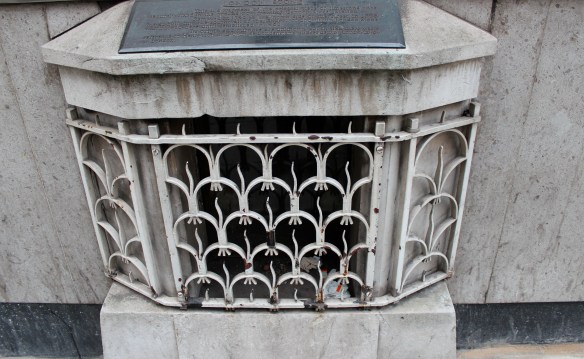
London Stone - note the delightful rubbish accumulating in the grille
Having been meaning to photograph London Stone for the Londonphile for a little while, you can imagine my surprise when I visited recently only to discover a very official poster announcing plans to relocate it. (Obviously I missed Londonist’s article about this last year!). Due to the imminent redevelopment of the 111 Cannon Street site, it is now proposed that London Stone be relocated from where it has resided since 1557, to the front of the Walbrook Building, at 97-101 Cannon Street.
So just what is this London Stone? In short, it is a rather unprepossessing 53cm wide, 43 cm high, 30cm deep (i.e. not really all that big) slab of oolitic limestone. Despite its name, as this particular limestone does not naturally occur in London it clearly originally hailed from elsewhere. London Stone has had numerous myths attached to it over the centuries, and has variously been held to be the remains of Brutus’ temple, the stone which held King Arthur’s sword, a Druid’s altarpiece or a Roman milestone. It is as the remains of Brutus’ temple that the stone acquired its alleged link to the well-being of London: it is said that ‘so long as the stone of Brutus is safe, so long shall London flourish’. The Victorian Society described the stone in their submission to the planning committee as ‘one of the most symbolically important objects in London’.
 The first records of the stone place it on the south side of Cannon Street (opposite number 111). It was larger then and eventually became something of an impediment to traffic (apparently traffic was already proving problematic back in 1742!), so was moved to the northern side by St Swithin’s church and later placed into the south wall of the church. Although St Swithin’s was destroyed during the Blitz, the stone survived intact – luckily for London – and has remained outside 111 Cannon Street since, currently in front of a rather grim 1960s office block. Unsurprisingly, all of the objections to the proposal (which can be viewed online – see the links below) centre around the significance of this site to London Stone, which renders any relocation inappropriate.
Having said that, English Heritage do concede in their submission that the stone’s current setting and presentation could do better. On my own visit I found the stone hard to view through both the grille and the glass, and mostly ignored by passers-by; filled with litter, it has the appearance of little more than a random piece of neglected street furniture. The light that normally illuminates the stone somewhat appeared to be out. The low setting of the stone however – while not an aid to viewing – is actually in keeping with its originally low position in the street, and most submissions felt this should also be retained.
 Currently the application to relocate the stone is still ‘pending consideration’. Hopefully this story will have a happy ending, with the stone able to remain in situ as part of the new building at 111 Cannon Street, and ideally in a way that also makes it easier to view, more celebrated and more cared for than it currently appears. Clearly, any developers would do well to keep in mind the stone’s link to the city’s safety when considering any plans…
You can view the planning submissions online at:
http://www.planning.cityoflondon.gov.uk:90/WAM/findCaseFile.do?councilName=Corporation+of+London&appNumber=11/00664/LBC



 thelondonphile